
Tesla CEO Elon Musk has unveiled the company’s long-awaited next-generation Roadster in a dramatic demonstration featuring a vehicle that appeared to fly using compressed-air thrusters. The event, held on October 15, 2026, at a SpaceX test facility in McGregor, Texas, showcased a futuristic combination of electric vehicle engineering and rocket technology.
During the livestreamed presentation, the Roadster accelerated up a curved ramp, remained attached to the surface as it turned upside down, and launched into the air before performing a midair flip and landing on its wheels. In another demonstration, the vehicle jumped over a line of parked cars and a semi-truck, highlighting the potential capabilities of its advanced propulsion system.
Musk explained that the vehicle uses ultra-high-pressure air tanks and integrated cold-gas thrusters developed through collaboration between Tesla and SpaceX. According to the company, the system can generate significantly greater thrust than the grip available from conventional car tyres, potentially improving acceleration beyond the limits of traditional road vehicles.
Tesla also demonstrated the Roadster’s claimed acceleration performance, with Musk stating that certain versions could accelerate from zero to 60 miles per hour in less than one second. The vehicle is also expected to achieve a top speed exceeding 230 mph, although these performance claims and the system’s real-world capabilities will require further verification.
“Flying cars are real,” Musk declared during the event. However, he acknowledged that the project’s success is not guaranteed, reflecting the considerable engineering challenges involved in developing a vehicle capable of both high-speed road travel and controlled flight.
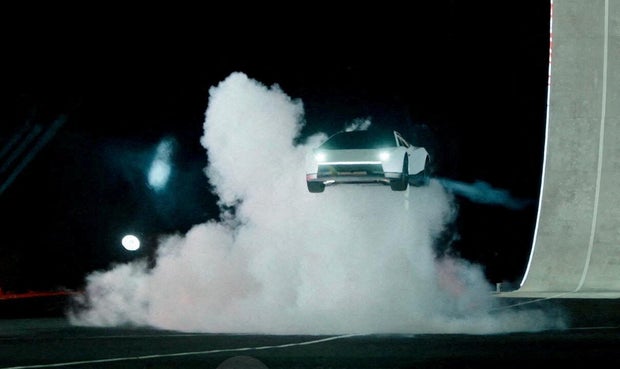
Despite the spectacular demonstration, important questions remain about whether the Roadster can achieve sustained flight rather than performing brief aerial jumps. The event did not demonstrate long-distance flight or establish how the vehicle would transition safely between ground travel and airborne movement under normal operating conditions.
Experts have long highlighted the challenges of combining road vehicles with aircraft. Flying vehicles must balance weight, structural strength, stability, propulsion efficiency and passenger safety. They must also satisfy strict aviation and road-safety regulations before becoming commercially available.
Tesla first introduced the Roadster concept in 2017, initially targeting deliveries in 2020. However, the project experienced significant delays. At Thursday’s event, company executives announced that production is expected to begin in 2028. Tesla has not confirmed the final price of the redesigned model, although the original announcement included a base price of approximately $200,000.
The unveiling represents an ambitious step towards integrating automotive and aerospace technologies. Nevertheless, the Roadster’s ability to deliver practical, safe and sustained flight remains unproven. Its eventual success will depend on further testing, engineering development, regulatory approval and whether the technology can be made reliable enough for everyday use.